Scroll to explore

Land of Eternal Spring

Baharestan Gardens

Where grief becomes a garden, and nature holds what we cannot.

Sheila Mahoutchian · Founder
June 2026

Plant a Seed Fund the Garden
What will you do when I die?

— Maryam Tabibzadeh, April 2026

The Origin

Baharestan means land of spring.

It is also the title of my mother's final book — the crowning achievement of her life's scholarship, which we designed and published together in her final weeks. She died on April 24, 2026.

She was frank about reality — which was often sober — but always turned her face toward the light. Toward flowers, pretty colors, and sweet smells. In her final weeks, watching her body fail while she was still so present, she could see how frightened I was. She kept asking the question. I didn’t have an answer. I couldn’t accept it yet.

She left the burial to us because she understood we were the ones who would carry the experience. I decided to have a willow planted at her grave because it honored who she was. What I encountered was a system that, even at its most accommodating, placed her in a biodegradable coffin inside a cement liner with a tree planted nearby. I was grateful. And I knew it wasn’t enough.

That experience, filtered through twenty years of work as an experience designer and builder, became a question: what if grief had somewhere warm to go?

The Problem

The current system fails families at the moment that matters most.

Transactional

Death care is optimized for throughput, not experience. Families receive a product, not a place they want to return to.

Cold & Static

Headstones and concrete liners ask grief to stop. Nothing grows. Nothing changes with the seasons. Nothing feeds the living.

Culturally Empty

Secular, progressive, and culturally specific families — including 400,000+ Persian-Americans in SoCal alone — have no meaningful option.

The Solution

What if grief had somewhere
warm to go?

Baharestan Gardens is a botanically designed memorial garden — the first of its kind — where the departed become trees, shrubs, roses, and wildflowers, and where the living come to tend them.

A grave is a destination. A garden is a relationship.

The Philosophy

Death is not the opposite of life.
It is the condition of it.

This is not a new idea. It is the oldest one. For as long as there have been gardens, the living have brought their dead into them — in Persian culture, in Japanese culture, across the ancient world. The garden is the logical answer to mortality: a place where the dead return to the living, and the living return to tend them.

A century of industrial death care separated the living from the dead, put them behind gates, under concrete, out of sight. Philosopher Stephen Jenkinson writes that a culture which hides death from itself becomes diminished, grief-illiterate, less alive. Dirt is everything that didn't make it. Without death there is no soil. Without soil nothing grows. Baharestan is built on this understanding. The grief that visits you here is not asked to leave. It is asked to plant something.

Nature is our religion. Tending is our practice. The garden is our sanctuary.

The Experience

A place designed for every part of grief.

I
garden
The Garden

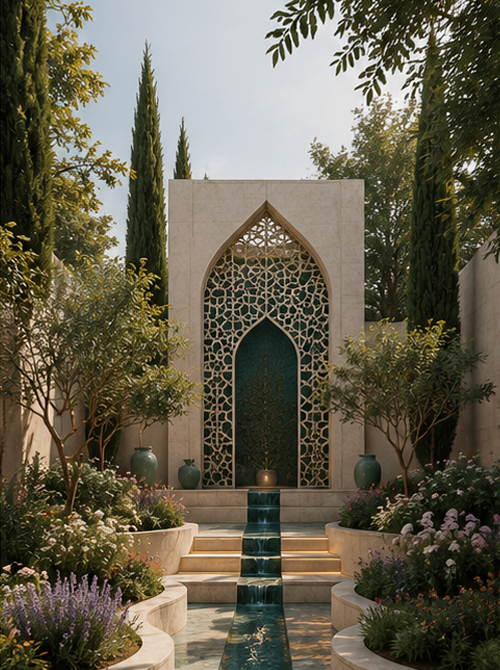
Ancient garden geometry where the departed become flowers for the living.

II
cottage
The Lodge

Ceremony, gathering, overnight stays. Always open to the garden.

III
blur_on
The Wailing Wall

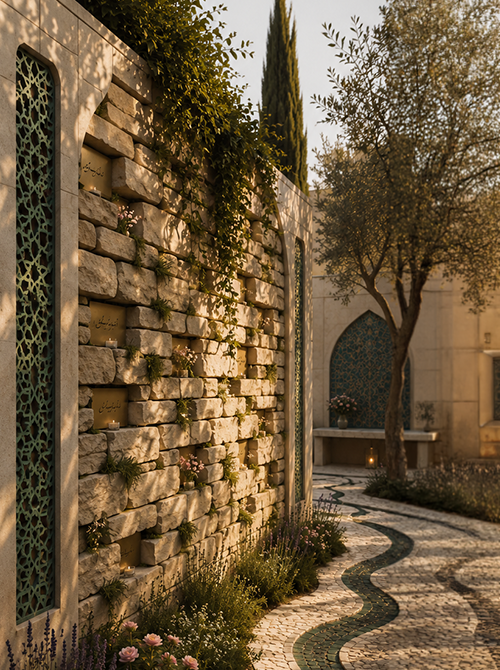
Dry-stacked stone, climbing roses, gaps for notes. Bring your grief whenever you need it.

IV
sync_alt
The Labyrinth

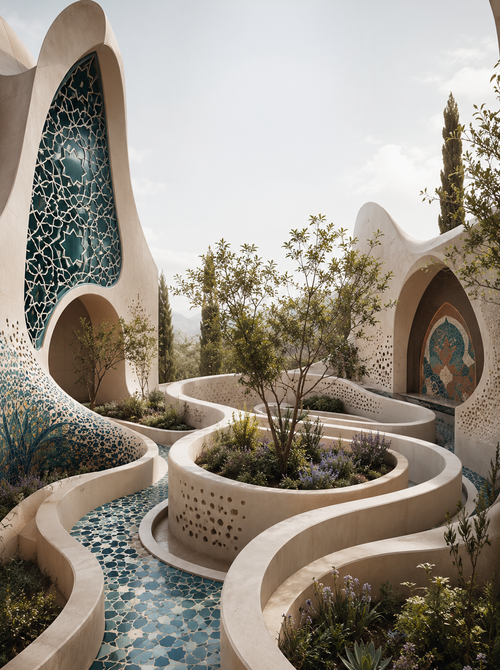
A path with no wrong turns. Draws you deeper, then returns you.

V
park
The Enchanted Forest

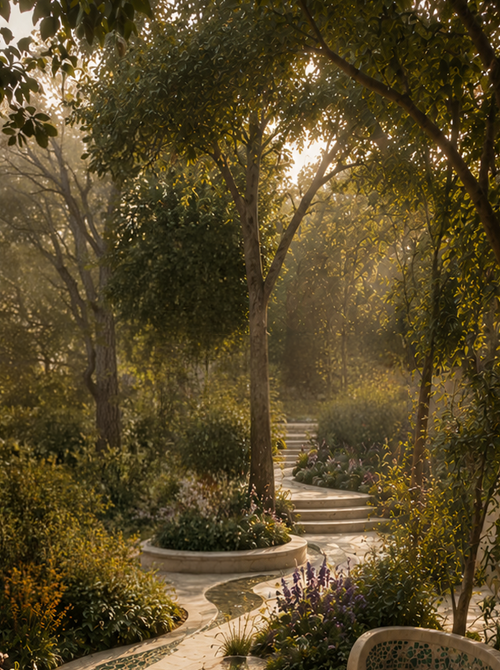
The wilder edges. Ancient canopy, the quiet of something older than grief.
The Garden
garden
The Garden

The designed heart of Baharestan. The chahar bagh — the ancient Persian four-quadrant garden that gave us the word paradise — is the organizing geometry of every location. Families choose a specimen matched to the personality of the life being honored. A climbing rose. A Japanese maple. A willow. A fruit tree. The departed are laid to rest beneath it and become part of something living. Botanically curated, climate-adapted, tended year-round.

The Lodge
cottage
The Lodge

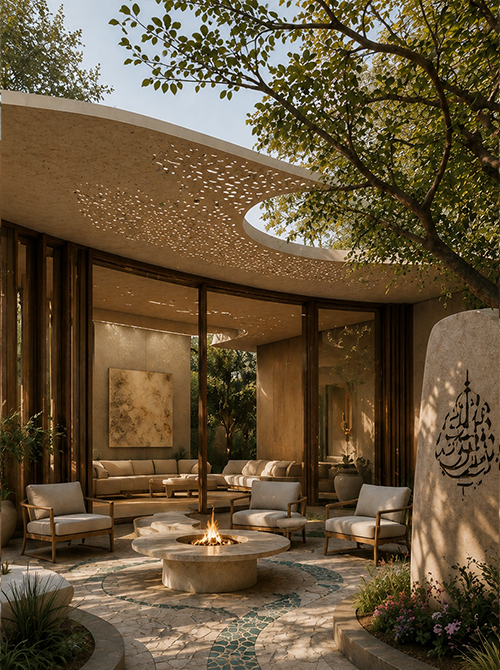
The gathering place at the heart of every Baharestan. Warm materials, natural light, always open to the garden. Families come here before and after planting ceremonies, for memorial salons, and to stay when they travel to tend their person. Not a funeral home and not a hotel — a threshold space designed to hold people who are between things.

The Wailing Wall
blur_on
The Wailing Wall

Dry-stacked stone, moss, climbing roses, gaps for notes and offerings. The Wailing Wall is always there — the first stop for visitors not yet ready for anything else. It asks nothing. You can bring your tears, your anger, your unformed grief and leave it in the wall. The inscriptions accumulate. The moss grows over them. It is always the most worn place in the garden.

The Labyrinth
sync_alt
The Labyrinth

A path with no wrong turns. The labyrinth draws you deeper into the space and then returns you — the same path in and out, but you arrive somewhere different. Every Baharestan has one. The design changes with each location — different stone, different planting, different scale — but the meaning is the same everywhere. It is the one element that asks nothing of you except that you keep walking.

The Enchanted Forest
park
The Enchanted Forest

The wilder edges beyond the garden geometry. Ancient canopy, large trees, the quiet of something older than grief. Where the garden dissolves into something that doesn't need you — a place that was here before any of us and will be here after. The departed are also laid to rest here, among the roots of trees that have been growing for a hundred years.
The people who need Baharestan are already here.
The place isn’t. Yet.

Join the founding community, or come invest in what we’re building.

Plant a Seed Fund the Garden